
Test Circuit used for ACID reverse engineering: Difference between revisions
From CPCWiki - THE Amstrad CPC encyclopedia!
More actions
No edit summary |
No edit summary |
||
| (3 intermediate revisions by 2 users not shown) | |||
| Line 31: | Line 31: | ||
Image:AcidTestHomeTop.jpg|Top | Image:AcidTestHomeTop.jpg|Top | ||
Image:AcidTestHomeBottom1.jpg|Bottom | Image:AcidTestHomeBottom1.jpg|Bottom | ||
Image:AcidTestHomeWorkplace.jpg|Nocash Headquarters | Image:AcidTestHomeWorkplace.jpg|Nocash Headquarters. | ||
</gallery> | </gallery> | ||
When I came back home, I wrecked the original circuit, and made a miniaturized adapter with robust centronics socket. Not that I'd still really needed it - I've been already done with the rev engineering at that time - I just don't like messy cables. | When I came back home, I wrecked the original circuit, and made a miniaturized adapter with robust centronics socket. Not that I'd still really needed it - I've been already done with the rev engineering at that time - I just don't like messy cables. | ||
[[Category: | [[Category:CPC Plus]][[Category:Cartridges| ]][[Category:DIY]] | ||
[[Category:CPC History | [[Category:CPC History]] | ||
Latest revision as of 22:07, 19 December 2010
ACID Reverse Engineering
Schematic
Source Code
For curiosity, here's the original source code used for reverse-engineering. It's barely commented or user-friendly.
Pictures
- Original messy circuit
-
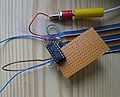 Top
Top -
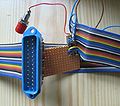 Bottom
 -
 Parents desk


This is original circuit, assembled while I was visiting my parents. I couldn't find a 36pin centronics socket, only a (very) old 25pin RS232 cable, so I needed to use that.
- Newer clean circuit
-
 Top
Top -
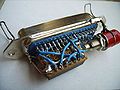 Bottom
 -
 Nocash Headquarters.


When I came back home, I wrecked the original circuit, and made a miniaturized adapter with robust centronics socket. Not that I'd still really needed it - I've been already done with the rev engineering at that time - I just don't like messy cables.