Maestro: Difference between revisions
No edit summary |
No edit summary |
||
| (7 intermediate revisions by one other user not shown) | |||
| Line 1: | Line 1: | ||
The Maestro from Vanguard Leisure Ltd. is a simple stereo amplifier with speakers and headphones, offered for use with Amstrad computers | The Maestro from Vanguard Leisure Ltd. is a simple stereo amplifier with speakers and headphones, offered for use with Amstrad computers. A similar package is the [[Sound Blaster]] from [[Siren Software]]. | ||
== Pictures == | == Pictures == | ||
| Line 8: | Line 8: | ||
File:Maestro_advert.jpg|Advert | File:Maestro_advert.jpg|Advert | ||
File:Maestro_demo_cassette.jpg|Demo Cassette | File:Maestro_demo_cassette.jpg|Demo Cassette | ||
File:Maestro_1.jpg|Maestro (front) | |||
File:Maestro_2.jpg|Maestro (front + leads) | |||
File:Maestro_3.jpg|Inside Meastro circuit board top | |||
File:Maestro_4.jpg|Inside Meastro circuit board bottom | |||
</gallery> | </gallery> | ||
| Line 24: | Line 28: | ||
* Designed by experts. | * Designed by experts. | ||
== | == Details == | ||
The | The Maestro has 3 leads. Two of these leads connect the Maestro to the CPC's power connection. | ||
The third lead connects to the CPC's 3.5mm stereo sound connector. | |||
[[Category: | On the back it has 2 DIN 41529 loudspeaker connectors. | ||
On the front it has two dials for adjusting the volume of the left and right sound channels individually, a connection for headphones and a button which chooses output to headphones or speakers. | |||
The Demo cassette contains a program which plays sound through the CPC's sound chip. It can be used to test that the sound is comming through the Maestro correctly. | |||
==Uselessness== | |||
Actually any stereo Hi-Fi can be plugged into the Jack sound port of the CPC. | |||
This is the ancestor of modern PC external speackers. | |||
[[Category:Music and sound]] [[Category:Peripherals]] | |||
Latest revision as of 20:31, 19 December 2010
The Maestro from Vanguard Leisure Ltd. is a simple stereo amplifier with speakers and headphones, offered for use with Amstrad computers. A similar package is the Sound Blaster from Siren Software.
Pictures
-
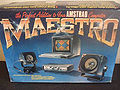 Package (cover)
 -
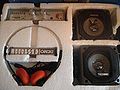 Package (inside)
 -
 Advert
 -
 Demo Cassette
 -
 Maestro (front)
 -
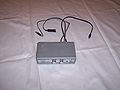 Maestro (front + leads)
 -
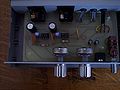 Inside Meastro circuit board top
 -
 Inside Meastro circuit board bottom


Features (as shown in the Advert)
- Powerful stereo amplifier which utilises the Amstrads full sound capabilities.
- Compatible with the 464, 664, and 6128 omputers.
- Very easy to use. Demonstration software included.
- Enhances most existing software in wonderful stereo.
- No external power supply needed.
- Works with ALL add on's.
- Complete with two high quality 30 watt double cone air suspension speakers in pod mounts, for group listening and a pair of lightwight headphones for personal listening.
- Range of music tapes which complement the Maestro perfectly.
- Can be used with your own Hi-Fi speakers.
- A must for all music lovers.
- Designed by experts.
Details
The Maestro has 3 leads. Two of these leads connect the Maestro to the CPC's power connection. The third lead connects to the CPC's 3.5mm stereo sound connector.
On the back it has 2 DIN 41529 loudspeaker connectors.
On the front it has two dials for adjusting the volume of the left and right sound channels individually, a connection for headphones and a button which chooses output to headphones or speakers.
The Demo cassette contains a program which plays sound through the CPC's sound chip. It can be used to test that the sound is comming through the Maestro correctly.
Uselessness
Actually any stereo Hi-Fi can be plugged into the Jack sound port of the CPC.
This is the ancestor of modern PC external speackers.